 +36 32 563 040
 info@sickft.hu
 +36 32 563 040info@sickft.hu
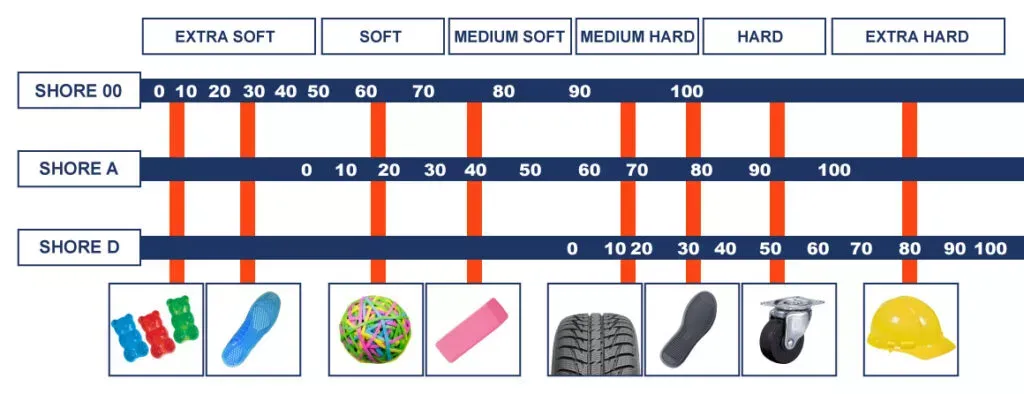
Rubber hardness testing is usually done using an indentation hardness measurement method, also known as a durometer. It was developed by Albert F. Shore in the 1920s, for measuring the hardness of polymers, elastomers and rubber products, and has several scales depending on the shape of the indenter used to apply pressure to the object under test. It is denoted by 00, 0, A, B, C, or D after the word Shore, that goes from extra soft to extra hard. There is an overlap between the scales from 0 to 100, thus materials can be on more than one scale but with different values.
Rubber products are mainly on the Shore A scale, for example, the tread of a car tire is typically 70, 70 Shore A.
The drawback of the test is that it cannot be used on small, less than 2 mm thick materials, and there is a potential for operator error when testing without a stand.
Two international standards are currently in use for wear testing. These are EN ISO 14890 (H, D and L) and DIN 22102 (Y, W and X). Products that comply with H (ISO) and X (DIN) are resistant not only to abrasion but to cutting, punching and chipping as well.
Proper testing is also standardized in ISO 4649 and DIN 53516. During the testing process, an abrasive surface is fixed to a rotating cylinder, the test object is moved on it and the reduction in the volume of the test object is measured. The result is the volume lost, the higher the number, i.e. the volume lost, the less resistant the material is to abrasion.
Wear resistance is an essential indicator of durability. Often, two or three cheaper products will run out, while a costly but more wear-resistant one can still be used. Therefore, when choosing a product, it is worth knowing both the standard category and the test value, as there may be variations within a category.
Testing according to ASTM D1148-13(2018) standard measures the effect of UV light on white or light-colored vulcanized rubber products such as sports shoes. The light source, temperature and humidity are controlled during the test, therefore a sealed unit is required that complies with the standard.
After the test, a colorimeter is used to compare the color of the piece exposed to UV light during the test with the new condition. The test results in a color difference, the higher the value, the less resistant the tested material was to the effects of sunlight.
Flexible elastomer and rubber products react to an external force by applying a counterforce. The ASTM D2632 test measures this force, deducing the elasticity of the rubber product.
The vertical rebound resilience test is performed by dropping a standard plunger vertically from a specified height onto a horizontally placed object six times in succession. The heights of the fourth, fifth and sixth rebounds are visually recorded and averaged. The result given in percentage indicates the elasticity of the tested rubber product.
The Mooney method measures the viscosity of mixed or unmixed natural rubber, synthetic rubber and regenerated rubber. It also shows how these materials react to the vulcanization process.
The machine heats the raw rubber material at a pre-programmed temperature and for a pre-set time, while continuously testing its viscosity. The results are easily displayed graphically.
The method tests the behavior of the material before, during and immediately after vulcanization. This process is used to determine the vulcanization process best suited to the raw material and the intended finished product.
The device measures the shear force required to overcome the actual viscosity of the material, and through this the viscosity of the material being tested.
During the process, a standard disc is embedded into the sample of raw rubber, which is placed into the machine, which then exerts rotation momentum on the disc.. The first measurement records the minimum torque required for rotation. Then the vulcanization process takes place, while the shear force required to overcome the viscosity of the rubber is measured at regular intervals.
With this method, it is possible to accurately determine the vulcanisation process that achieves the best viscosity from a given raw material.
The Mooney method measures the viscosity of mixed or unmixed natural rubber, synthetic rubber and regenerated rubber. It also shows how these materials react to the vulcanization process.
The machine heats the raw rubber material at a pre-programmed temperature and for a pre-set time, while continuously testing its viscosity. The results are easily displayed graphically.
The method tests the behavior of the material before, during and immediately after vulcanization. This process is used to determine the vulcanization process best suited to the raw material and the intended finished product.
The device measures the shear force required to overcome the actual viscosity of the material, and through this the viscosity of the material being tested.
During the process, a standard disc is embedded into the sample of raw rubber, which is placed into the machine, which then exerts rotation momentum on the disc.. The first measurement records the minimum torque required for rotation. Then the vulcanization process takes place, while the shear force required to overcome the viscosity of the rubber is measured at regular intervals.
With this method, it is possible to accurately determine the vulcanisation process that achieves the best viscosity from a given raw material.
At SIC, we ensure that every product is made from the best material for the intended application, thus developing the product for the challenge at hand. Testing is always part of the engineering process, to ensure that the material is suitable for the intended application. If you need a rubber component that meets your specific requirements, don’t hesitate to contact us.



Connect with us on social media for exclusive updates, behind-the-scenes insights, and direct access to our team. Join the conversation and stay informed about our latest innovations.